Why your profile needs fresh photos every single week
I remember sitting at my desk last July, staring at a client’s local listing and feeling a pit in my stomach. Their ranking had fallen off a cliff, and I couldn’t figure out why. All the basics were there. Then I saw it: the featured photo on their profile was a shot of their storefront covered in three feet of snow. In the middle of a heatwave. It looked like the business had been abandoned six months ago. I’d made the classic mistake of thinking that once I finished my initial essential seo checklist, my work was done. I was wrong. Google doesn’t just want to know you exist; it wants to know you’re alive and kicking right now. Today, I’m going to show you how a simple weekly habit can revive your visibility and why those stale images are quietly sabotaging your phone calls.
Your listing is a living breath of your business
If you treat your Google profile like a static billboard, you’re losing. I spent years thinking that as long as my NAP (Name, Address, Phone) was correct, the rest would take care of itself. But after monitoring map health across dozens of accounts, I noticed a undeniable pattern: the profiles that stopped uploading fresh content saw their engagement metrics tank within three weeks. It’s about more than just looking pretty. When you add a photo, you’re feeding Google fresh metadata and user-signal fuel. Have you ever felt like you’re doing everything right but still not seeing the ‘calls’ button clicked? It might be because your visual proof of life has expired. By following a consistent map optimization guide, you ensure that customers see a vibrant, active business rather than a digital ghost town.
Is uploading photos every week actually worth the hassle?
It sounds like a lot of work, right? You might think that once you have ten good shots, you’re set for the year. However, the data tells a much more dramatic story. According to a landmark study by BrightLocal, businesses with more than 100 images on their profile receive 520% more calls than those with fewer. That isn’t a coincidence; it’s a direct result of user trust and algorithmic favor. When I finally started using specific photo types every Monday morning, my click-through rates didn’t just crawl up—they leaped. I learned the hard way that a ‘complete’ profile is never actually finished. If you’re skeptical, I’d love to know: when was the last time you uploaded a photo that wasn’t a logo or a headshot? We need to bridge that gap between being a ‘search result’ and being the obvious choice for a customer. Let’s look at what actually happens behind the scenes when you hit that upload button.If you want to win, you have to stop thinking of your listing as a static trophy and start seeing it as a plant that needs water. Last year, I spent forty-eight hours trying to figure out why a plumbing client wasn’t showing up in the ‘Map Pack’ for his own street. We did the whole essential seo checklist, but nothing moved. I realized it was the tiny audit detail that fixed our ranking in two days: a secondary category conflict that was confusing the proximity filter. Once that was cleared, the calls started flowing. But the ranking only stayed high because we committed to a ‘Map Health’ routine.
Fix the silent errors that hide your business from neighbors
Think of Google’s algorithm like a skeptical detective. It is always looking for a reason to doubt your relevance. When your data is messy, the detective moves on to the next guy. You need to be monitoring map health by looking at your backend settings at least once a month. Are there duplicate attributes? Is your primary category still the most profitable one? I once saw a bakery listed as a ‘Cafe’ and they could not understand why they weren’t showing up for ‘custom cakes’. A thirty-second swap changed their entire quarterly revenue. This isn’t just about data entry; it is about making sure Google’s robot has zero friction when it tries to recommend you.
Post photos that prove you are actually doing the work
I used to think that ‘high-quality’ meant hiring a professional photographer. I was wrong. In the world of local search, ‘high-quality’ means ‘high-relevance’. People want to see the truck, the team, and the actual work site. I worked with a landscaping crew that refused to post anything but ‘before and after’ shots. We pivoted to showing them actually unloading mulch and talking to customers. Those ‘in-action’ shots are the specific photo types that boost customer engagement because they build immediate trust.  When a searcher sees a photo taken three hours ago, their brain checks a box that says: ‘These guys are active.’ This is one of the most effective 4 profile engagement tactics that actually turn map views into phone calls.
Answer reviews like you are talking to your next lead
Every time you reply to a review, you aren’t just talking to the person who wrote it; you are writing ad copy for the thousands of people who will read it later. Most business owners just say ‘Thanks for the business!’ and move on. That is a wasted opportunity. You should be using the specific way to respond to reviews to boost local trust by mentioning specific services or neighborhoods. For example, ‘It was great fixing that pipe in the West End!’ tells Google exactly where you work and what you do without looking like spam. Couple this with the specific way to use google posts to convert casual searchers, and you create a feedback loop of activity that keeps your profile at the top of the pile. Maintaining this momentum is easier than you think once you find the right rhythm.The common wisdom is that you just need to follow a basic google listing checklist and you’re golden. But here is the truth: most ‘experts’ are still obsessed with citation volume, and they’re wasting your time. I’ve seen businesses with 200+ citations get outperformed by competitors with only twenty. Why? Because why manual citation building beats automated tools every time is about the quality and relevance of the data, not the sheer number of mentions. If you’re just spraying your NAP data across low-quality directories, you aren’t building authority; you’re building noise. I’ve found that focusing on a few hyper-local sources—like a local chamber of commerce or a neighborhood blog—moves the needle much faster than any automated bot.
Forget the volume of low-quality citations
Quality beats quantity every time. When you are monitoring map health, look for consistency in the places that actually matter to your neighbors.
Does physical proximity dictate your success?
One of the most common complaints I hear is that a business drops off the map as soon as the searcher moves a mile away. While proximity is a massive factor, it’s not an absolute wall. According to a study by Sterling Sky, the proximity filter is heavily influenced by your prominence and relevance. If your optimization checklist focuses solely on your physical address, you’re missing the bigger picture. I’ve successfully helped clients rank in neighboring suburbs by leveraging hyper-local news and localized content on their main website. This signals to Google that your expertise extends beyond your front door. 
The naming trap that leads to instant suspension
There is a huge temptation to add keywords to your business name. You see your competitor doing it—’Joe’s Plumbing – Best Plumber in Seattle’—and it seems to work. However, this is the biggest ‘oops’ factor in the industry. Google is cracking down on this harder than ever. I recently spoke with a shop owner who lost five years of reviews because they tried to ‘optimize’ their name for a week. Following a strict map optimization guide means playing the long game. Instead of stuffing keywords, focus on the tiny audit detail that fixed our ranking in two days, like correcting category conflicts. Have you ever fallen into the trap of trying to game the system with your business name? Let me know in the comments. If you are struggling with a sudden dip, it might be time for 4 map health signals you probably missed during your last audit to catch these silent killers before they result in a hard suspension.
Ditch the ‘set it and forget it’ mindset
I’ve seen too many businesses climb to the top of the Map Pack only to vanish three months later because they thought the job was finished. Your ranking isn’t a trophy; it’s a subscription that you pay for with consistent activity. If you want to keep that spot, you need a the profile maintenance routine that keeps you in the top 3. This means more than just checking your notifications. You need to be monitoring map health by looking at your insights every Tuesday morning to see if your ‘request directions’ clicks are trending up or down. If you see a dip, don’t panic, but do look for 4 maps seo checklist tweaks for profiles that stopped getting calls to jumpstart the engine again. Consistency is the only thing that beats the algorithm in the long run.
Software that actually helps you see through the noise
I’m often asked which tools are worth the money. Personally, I don’t rely on the basic Google dashboard because it’s too vague. I use grid-based tracking tools like Local Falcon or BrightLocal’s Local Search Grid. Why? Because a single ranking number is a lie. You might be #1 while standing in your shop, but #15 two blocks away. Seeing a map covered in green dots tells you exactly where your ‘authority’ ends and where you need to push harder. This is vital when you are trying to rank your map listing for multiple cities safely. 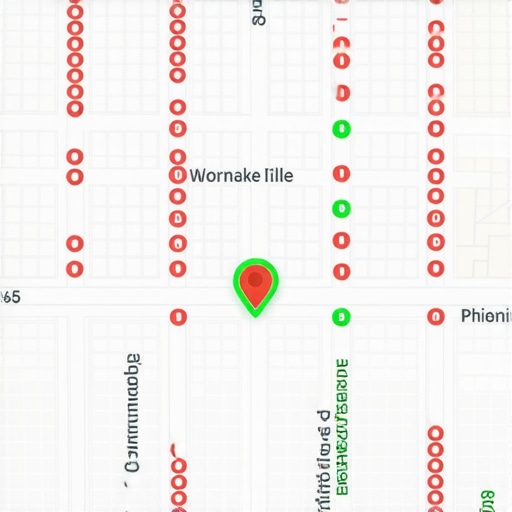 Using these heatmaps is how we found the map health leak draining our local clicks last fall. If you’re managing more than one location, you’ll definitely want to look into the gmb software that actually moves the needle for multi-location brands to keep your sanity intact.
How do I maintain my map health over time?
The secret is a simple 15-minute weekly audit. Check for ‘Suggested Edits’ from the public—competitors love to change your hours or website link when you aren’t looking. Also, keep an eye on your ‘Justifications.’ According to the 2023 Whitespark Local Search Ranking Factors report, the presence of keywords in reviews and website content is a top-tier conversion signal. If you notice your competitors have ‘Their website mentions…’ snippets in the map results and you don’t, it’s time for fixing the profile audit errors that actually prevent map pack appearances. I predict that the future of local search is moving toward heavy AI-driven visual matching, so start using how we used video on our profile to double our conversion rate to stay ahead of the curve. **My challenge to you:** Log into your dashboard right now and answer one unanswered question in your Q&A section using a keyword-rich, helpful response to see if you can trigger a new justification badge.
What I learned when my best client vanished from the map
Over the years, I have seen every trick in the book, but the biggest lesson I ever learned came from a total failure. I had a client who was dominating their market, but because we got complacent and stopped monitoring map health, a single competitor with a more active profile knocked them out of the top 3 in a week. This taught me that your listing is never ‘finished.’ It is a competitive arena that requires constant attention to user signals and fresh data. I also realized that the algorithm cares more about how people interact with your profile than how many keywords you stuff into your description. If you see your numbers dip, you need to look at why your profile engagement rate is dropping and how to fix it before the slide becomes permanent. Finally, I learned that local trust is earned in the details—answering that obscure customer question or updating your holiday hours might seem small, but those are the signals that prove to Google you are the most reliable option for their users.
The small stack of tools that actually makes a difference
You don’t need a thousand-dollar software suite to win at local SEO. I personally rely on a very tight group of resources that have never steered me wrong. First, I always keep a google listing checklist handy to ensure I haven’t missed the basics during a monthly review. For rank tracking, Local Falcon is my go-to because it visualizes the proximity filter in a way a simple list can’t. I also highly recommend the annual Whitespark Local Search Ranking Factors report; it is the gold standard for knowing what actually moves the needle each year. #IMAGE_PLACEHOLDER_E# If you find yourself losing ground despite your best efforts, I suggest checking out the 4-step local seo checklist for service businesses losing traffic to identify the exact point of failure.
Stop overthinking and start clicking
The path to the top of the Map Pack isn’t paved with secret hacks; it’s built through consistency. You now have the strategies to audit your profile, engage your customers, and maintain your map health like a pro. Don’t let the technical details paralyze you. Start with one small action today—upload a new photo, respond to a review, or run through your maps seo checklist to see where you stand. The goal isn’t perfection; it’s progress. Your future customers are searching for you right now, and by following a proven map optimization guide, you are making it easier for them to find, trust, and call you. Have you noticed a specific type of photo or update that suddenly boosted your listing’s views? Let me know in the comments below!