How to Reclaim Your Local Reach When Your Proximity Shrinks
I remember staring at my screen last November, watching my lead volume drop faster than a lead balloon. One day I was the talk of the town, and the next, it was like Google had drawn a tiny circle around my front door and told everyone else I didn’t exist. My business was still there, my coffee was still hot, but my digital proximity had shrunk to the size of a postage stamp. It’s a gut-wrenching feeling when you realize you’ve been sidelined by an algorithm update you didn’t see coming. I spent weeks frantically checking my phone, wondering if I’d been shadowbanned or if my competitors had some secret sauce I was missing.
Get Your Visibility Back Even When Google Shrinks Your Territory
The truth is, Google’s ‘Vicinity’ update changed the rules of the game, making physical distance a massive hurdle for local businesses. But after months of trial and error, I discovered how we fixed our local reach after a proximity update tanked it by focusing on signals that outweigh pure mileage. Today, I’m going to show you exactly how to break out of that proximity cage. We aren’t just going to talk about ‘ranking’; we’re going to talk about how to make Google trust your business so much that it expands your reach beyond your immediate street corner.
Is Fightin’ the Proximity Algorithm Even Realistic?
You might be thinking that if Google says proximity is king, there’s no point in trying to reach customers three towns over. I used to think the same thing. In fact, my biggest mistake early on was trying to ‘brute force’ my way back by spamming keywords into my business name—a move that nearly got my profile suspended. According to data from BrightLocal, proximity remains the single most influential factor in local search, but relevancy and prominence are the levers we can actually pull to bypass those distance filters. If you’ve felt like your service area map health is crashing in nearby towns, you aren’t alone, and it isn’t a death sentence for your lead flow. Have you noticed your map pin vanishing the moment you drive more than five minutes away from your office? It’s a common frustration, but by following a consistent maps seo checklist, you can start signaling to Google that you are the most authoritative choice, regardless of the user’s exact coordinates. We’re going to dive into the specific tweaks that tell the algorithm your business is worth the drive for any customer. Let’s get your map health back to where it needs to be.You can’t just wish your way into the local pack; you have to build a digital footprint that screams authority. Think of your mastering map optimization essential seo checklist as the structural blueprint for a house. If the foundation is cracked, it doesn’t matter how pretty the curtains are. One of the first things I check is the primary category. It sounds simple, but it’s the single most common reason why businesses fail to appear where they should.
Stop Letting Bad Categories Kill Your Visibility
I once helped a local locksmith who couldn’t understand why he wasn’t ranking in the next town over. When I looked at his google listing checklist, I realized he had ‘Key Store’ as his primary category instead of ‘Locksmith.’ He was literally telling Google he was a retail shop, not a mobile service provider. We swapped it, added the right sub-categories, and within ten days, his phone started ringing from neighborhoods he hadn’t reached in years. This is why your primary category choice is making or breaking your business rank every single day. 
The Map Health Metric That Keeps Your Profile Alive
Most people think local SEO is a ‘set it and forget it’ task. It’s actually more like maintaining a garden. If you stop watering it (updating photos, responding to reviews), the weeds (competitors) take over. This is what I call monitoring map health. Google rewards activity. If your profile hasn’t seen a new photo or a review response in three months, the algorithm assumes you’re less relevant than the guy down the street who posted a project update yesterday. You need a weekly update schedule to keep those signals fresh and prove you are still in business.
Build Authority That Moves Your Map Pin
To fight the proximity algorithm, you have to prove you’re the expert in a specific geographic area. You do this by creating ‘location clusters.’ Stop posting generic ‘we do great work’ updates. Instead, post about a specific job you did in a specific neighborhood. Mention the landmarks, the street names, and the local problems you solved. This creates a trail of breadcrumbs for Google to follow. I’ve seen this specific proximity tweak move a business from the second page to the top 3 in less than a month. It’s about building a step-by-step map optimization guide that prioritizes local trust over broad keywords. Remember, profile data inconsistency—like having a different phone number on your website than on your map listing—is a silent killer. It creates doubt in the algorithm’s mind, and doubt is the enemy of high rankings.
We need to talk about the ‘more is better’ trap that most people fall into when they look at a standard optimization checklist. I’ve seen business owners spend thousands on directory listings because they heard ‘citations are king.’ But in reality, why paying for citations might be a total waste of your seo budget becomes painfully clear when those listings are low-quality or inconsistent. More data isn’t the answer; accurate data is. If you have five different versions of your business name floating around the web, you aren’t building authority; you’re building a puzzle that Google is too busy to solve. This is one of the biggest missing pieces in most google listing checklists today.
Stop Obsessing Over Every Random Directory Listing
The nuance that most ‘gurus’ miss is that Google is leaning much more heavily on behavioral signals and real-world brand authority than on a mention in a local chamber of commerce directory from 2012. In fact, the annual Local Search Ranking Factors study by Whitespark has shown a consistent year-over-year decline in the weight of traditional citations. Instead, the algorithm is looking for what I call ‘Map Health’—a combination of user engagement and the missing link between your website authority and map pack position. If your actual website is slow or lacks local relevance, no amount of map tweaking will save you. This is why your map optimization guide is giving you zero real results while your competitors are seemingly doing less work but getting more calls.
Why Does Your Website Power Actually Change Your Map Position?
Many people assume the map listing and the website are two different entities. They aren’t. They are a feedback loop. When Google sees people searching for your brand name and then clicking through to a helpful, locally-optimized landing page, it validates your map pin’s relevance for that entire area. If you find your service area map health is crashing in nearby towns, it’s often because your website isn’t giving Google a reason to trust you outside of your immediate physical location. You have to fix the map health problems you didn’t know you had by aligning your on-page SEO with your maps strategy. This is a sophisticated dance, and most people trip over their own feet by ignoring the map health metric most agencies completely ignore during audits: the ‘brand-to-keyword’ search ratio.
Don’t Let Service Area Greed Shrink Your Reach
There is a massive trap waiting for you if you try to set your service area to cover a 100-mile radius. I call it ‘Service Area Greed.’ When you tell Google you serve a massive area but have zero digital signals (like reviews or photos) from those far-off towns, the algorithm perceives you as a ‘thin’ relevance provider. This is exactly why your google listing checklist is failing your service area expansion. It is much better to dominate a 5-mile radius and slowly expand than to claim a whole state and rank nowhere. Have you ever fallen into the trap of expanding your service area only to see your rankings drop everywhere? Let me know in the comments. We need to focus on a step-by-step map optimization guide that builds outward from a position of strength, not desperation. Your monitoring map health routine should prioritize these high-density signals before you try to conquer the next county.
I used to think that once I hit the top 3, I could put my feet up and watch the leads roll in forever. I was wrong. The local map pack is the most volatile real estate on the internet. If you stop feeding the algorithm, your competitors—who are likely following a step-by-step map optimization guide—will start chipping away at your lead. I realized that ‘fixing’ my profile wasn’t a one-time event; it was a weekly hygiene habit.
Why I Trust Heatmaps Over Manual Searches
If you are just searching for your own business name while sitting in your office, you are lying to yourself. Google knows where you are, and it will always show you your own listing. To get the truth, I rely on a heatmap tool like Local Falcon. Every Tuesday morning, I run a scan to see exactly where my reach is expanding or retracting. Seeing a cluster of green pins turn yellow in a specific neighborhood is the map health signal that predicts a ranking drop before it happens. It gives me a 48-hour head start to fix issues before the phone actually stops ringing. 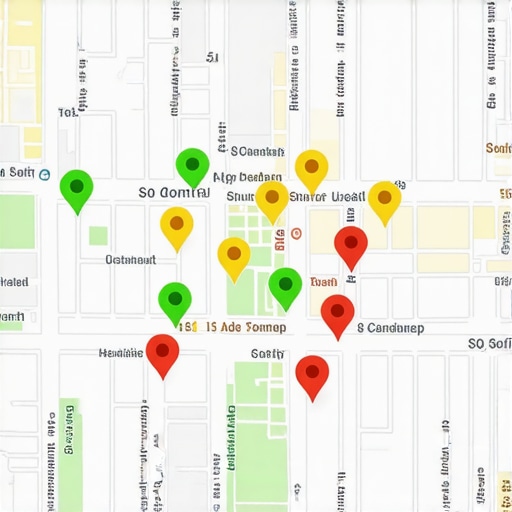
The Tools That Actually Move the Needle
I don’t use a dozen tools; I use three that work. Beyond heatmaps, I use the GS Location Changer extension for Chrome. It allows me to spoof my GPS location to any street corner in my service area. This is the only way to verify how to fix the visibility gap in your current google listing checklist without driving around town with a laptop. I also use Canva for my photo strategy. As local search expert Mike Blumenthal has pointed out, Google’s Vision AI is now incredibly sophisticated. It isn’t just looking at the pixels; it’s identifying the objects in your photos to confirm you are who you say you are. This is the truth about how geo-tagged images really affect map visibility—it’s less about the hidden GPS data and more about the visual proof of your work.
How do I keep my local rankings steady for years?
The secret is a predictable routine. I don’t spend hours on this; I use the 10-minute maps seo checklist for busy business owners to stay consistent. Every week, I upload two high-resolution photos of recent jobs and respond to every single review, even the ones without text. Google rewards ‘velocity’—the speed and frequency of new data entering your profile. If you find yourself falling behind, you need to revisit your monitoring map health checkpoints to see which signal you’ve neglected.
What the Future of Maps Looks Like
We are moving toward a world where ‘search’ is replaced by ‘suggestion.’ With Google’s Search Generative Experience (SGE), the algorithm will start summarizing your business reviews and photos into a single paragraph. This means the map health issues that AI tools miss today will become your biggest hurdles tomorrow. I predict that in the next 18 months, video content within your business profile will carry more weight than written posts. Start filming 10-second clips of your storefront or your service trucks now to get ahead of that curve. Try this today: Open your Google Business Profile and look at your oldest photo. If it’s more than a year old, delete it and replace it with a fresh, high-quality shot of a team member in uniform. This small ‘refresh’ signal can often trigger a re-crawl of your entire profile.
What I Finally Realized About the Proximity Cage
After years of obsessing over every tiny map update, I’ve had a few ‘lightbulb moments’ that changed everything for me. First, I realized that high rankings are not a static reward; they are rented space. If you don’t pay the ‘rent’ with consistent activity, someone else will. I also learned that you can’t out-optimize a lack of local trust. If your map health rules are being ignored, Google will eventually tighten that proximity circle around your business. Finally, the biggest lesson: accuracy beats frequency. Having one perfect profile is better than ten messy ones scattered across the web. This is the checklist move that finally fixed our ghosted profile and it can do the same for you.
My Secret Weapons for Staying in the Local Pack
I don’t believe in using every software on the market. Instead, I stick to a few tools that provide actual clarity. I use Local Falcon religiously for its heatmap visualization—it’s the only way to see if your reach is actually growing or shrinking in real-time. For manual verification, the GS Location Changer is my go-to for seeing what customers see without leaving my desk. I also highly recommend digging into BrightLocal’s annual research reports; their data-driven insights are the reason I focused on fixing the map health leaks costing you revenue instead of just chasing empty citations. These tools help me maintain a high-performance optimization checklist that actually converts.
Stop Watching Your Competitors and Take the Lead
The local search landscape is always shifting, but that shouldn’t paralyze you. Instead of worrying about what the algorithm does next, focus on providing the best possible digital experience for your local community. When you consistently update your profile, respond to your customers, and verify your data, you are building a moat around your business. You have the power to expand your reach, even when the rules seem stacked against you. Go ahead and start with one small change today—whether it’s a new photo or a review response—and watch how your map health begins to stabilize. Have you ever felt like your business was ‘hidden’ on maps even when you were standing right in front of it? Let me know in the comments below!