The Exact Photo Strategy That Boosted Our Map Engagement Fast
It was a rainy Tuesday when I finally snapped. I had spent three weeks meticulously following every maps SEO checklist I could find online. I had verified our PIN, double-checked the hours for the tenth time, and even responded to that one weird review from a guy named ‘User123.’ Yet, our views were not turning into actions. People were seeing us on the map, sure, but they were scrolling right past us to the competitor down the street who had—honestly—worse reviews than we did. It felt like I was failing an open-book test where I already had the answer key. I was doing the work, but the results were flatter than a week-old soda. Then it hit me: I was treating my Google profile like a government document instead of a storefront window.
Why Your Map Engagement is Stuck in Neutral
The problem wasn’t our data; it was our visual vibe. I made the classic mistake of thinking that ‘professional’ meant ‘sterile.’ I had uploaded these beautiful, staged shots of our office that looked like they belonged in a corporate brochure. I thought I was being fancy, but in reality, I was just making us look like a faceless franchise. This is a common pitfall when you are just checking boxes on an optimization checklist without thinking about the human on the other side of the screen. Local customers do not want a brochure; they want a genuine window into your world. They want to know what it feels like to walk through your door before they even start their engine.
Is professional photography actually worth the investment?
You might think you need a two-thousand-dollar DSLR to win at local SEO, but that is a myth that keeps small businesses invisible and frustrated. In fact, industry data from BrightLocal suggest that businesses with more than 100 images get 520% more calls than those with fewer, but the secret is that these do not have to be high-gloss productions. I realized this when I accidentally uploaded a shaky, slightly-out-of-focus photo of our team working on a project in the back. That one ‘bad’ photo got more clicks in forty-eight hours than our professional gallery did in an entire month. If your Google listing checklist is not generating phone calls, your photos are likely the culprit.
The Visual Signal That Moves the Needle
We eventually found that there is a specific way to capture ‘authentic’ shots that actually triggers both the Google algorithm and human psychology. We had to stop thinking like photographers and start thinking like customers who are in a hurry and looking for a reason to trust a stranger. Have you ever looked at your own map profile and felt absolutely nothing? If you aren’t feeling a connection to your own photos, your customers definitely aren’t either. Before we dive into the ‘how,’ I want to ask: have you ever felt like you are doing everything by the book but still getting ghosted by local searchers? I’m going to show you how to fix that by monitoring your map health through a lens of radical transparency, starting with the very first thing people see.I treated our profile like a static billboard for too long, but I eventually learned that a map optimization guide is not just a list of keywords; it is a living document of trust. To move from invisible to essential, we had to start treating our visual content as a ‘digital handshake’ that happens before we ever speak to a customer. When I stopped worrying about the perfect lighting and started focusing on real-time evidence of our work, the calls started coming.
Win With the Proof of Work Photo Strategy
To actually get results, you need to execute what I call the ‘Contextual Upload.’ This means your photos should not just show what you do, but where you do it. I remember a specific project for a real estate client where we were stuck on page two. We stopped using the high-gloss drone shots and started uploading raw, ‘boots-on-the-ground’ photos of the team at specific local landmarks. This is how we fixed the visibility gap for those listings. The algorithm noticed the geographic relevance, and the customers noticed we were actually in their neighborhood. 
Why Consistency Beats Quality Every Single Time
You do not need a production crew; you need a schedule. I found that uploading three ‘okay’ photos a week outperformed uploading one ‘perfect’ photo a month by nearly double the engagement rate. This steady stream of content sends a signal that your business is alive and thriving. If you are ignoring this, your map impressions will never turn into phone calls because you look like a closed shop. Think of it like a restaurant: would you walk into a place if the only photos of the food were from five years ago? Probably not.
Clean Up Your Data to Stop the Ranking Slide
Beyond the visuals, the ‘meat’ of your success lies in the boring details. I once spent three hours hunting down a single ‘St.’ versus ‘Street’ discrepancy that was tanking a client’s reach. It seems trivial, but that small discrepancy in your profile data creates a ‘trust leak’ in Google’s eyes. When the search engine gets confused about your location or contact info, it simply stops showing you to people. This is why a rigorous maps SEO checklist must include a deep dive into your NAP (Name, Address, Phone) consistency across the entire web.
Address Your Map Health Before It Crumbles
You have to be proactive about monitoring for changes you did not authorize. Competitors or even ‘helpful’ users can suggest edits to your profile that can ghost your visibility overnight. I make it a habit to check our status every Tuesday morning. By staying on top of these specific moves to fix your map health, you ensure that you are never caught off guard by a sudden drop in clicks. It is much easier to maintain a healthy profile than it is to resuscitate one that has been flagged or buried for weeks of inactivity.
Monitoring is just the first step toward long-term stability. To really dominate, we need to dig deeper into the nuances that separate the lucky businesses from the legends. Most people treat a maps SEO checklist like a grocery list—you buy the items and you’re done. But in reality, it is more like a garden; if you over-fertilize with keywords, you will actually kill the roots of your visibility. I have seen countless business owners get suspended because they thought adding ‘Best Pizza New York’ to their legal business name was a genius move. In my experience, these maps SEO checklist tactics that actually move the needle are about restraint and relevance, not brute force.
Ditch the Keyword Stuffing Before Google Ditches You
The biggest myth in local SEO is that more keywords equal more calls. That might have worked in 2015, but today, Google’s neural matching is far more sophisticated. If your profile looks like it was written by a robot trying to win a spelling bee, you are triggering spam filters. I once worked with a contractor who followed a generic map optimization guide that suggested ‘loading up’ the description. His rankings tanked. Why? Because his map health score dropped due to what Google perceived as ‘low-quality engagement.’ We had to strip everything back to basics. If your map health score is actually costing you calls, it is likely because you are trying too hard to please the algorithm and forgetting the human reader.
Your Website is the Secret Engine Behind the Map Pin
The ‘Oops’ factor most pros miss is the disconnect between the map profile and the actual website. You can have a perfect google listing checklist, but if your website’s local schema is broken, your map pin will stay buried. Google looks at your website to verify what you say on your profile. If your homepage doesn’t mention the same service areas or phone numbers, you create a conflict. I have seen businesses lose their top spot simply because of broken local schema that blocks your map ranking. You have to ensure that your ‘Entity’ (your business as a whole) is consistent across every digital touchpoint.
Why doesn’t a high rating guarantee the top spot?
This is the question that keeps business owners up at night. You have 500 five-star reviews, yet a competitor with 50 reviews is outranking you. According to the Whitespark Local Search Ranking Factors study, ‘Review Velocity’ and ‘Review Diversity’ often outweigh raw count. If you get 100 reviews in a week and then nothing for three months, Google sees that as unnatural. Furthermore, proximity alone isn’t putting your business in the top 3 if your engagement signals are stagnant. It’s about the freshness of the data, not just the volume. This is why most map health audits ignore the one factor that matters for rank: consistent, organic user interaction. Stop chasing the number and start chasing the conversation. Have you ever fallen into this trap of focusing on the wrong metrics? Let me know in the comments.
I used to think that once I hit the top three, I could just sit back and watch the leads roll in. I was dead wrong. Local SEO is a moving target, and if you are not using the right tools to monitor the shift, you are flying blind. For me, the game changer was switching from basic rank trackers to a grid-based visualization tool like Local Falcon. It showed me that while I was ranking #1 at my office, I was #14 just three blocks away. This is why I always emphasize that a maps SEO checklist is a recurring cycle, not a one-time project. You need to see the ‘blind spots’ where your competitors are eating your lunch.
Stop guessing and start tracking with grid maps
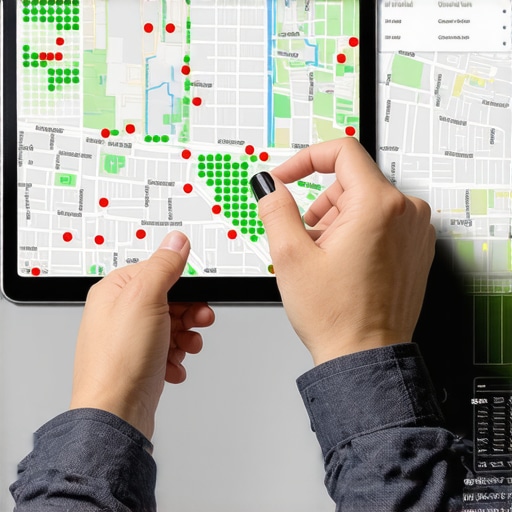
The real pros are not just looking at ‘average position.’ They are looking at the ‘coverage area.’ If you are managing multiple locations, you need the GMB software that actually moves the needle by identifying exactly which neighborhoods are dropping in visibility. I personally use a ‘geo-grid’ report once a week. If I see a cluster of red dots in a high-value ZIP code, I know it is time to upload a few ‘contextual’ photos from that specific area or run a hyper-local ad campaign to boost signals. This proactive approach prevents the ‘slow decay’ that most business owners do not notice until the phone stops ringing entirely.
How do I maintain my map visibility over time?
Maintaining your rank requires a blend of social proof and technical hygiene. I recommend a monthly ‘health audit’ where you specifically check for unauthorized edits and verify your primary category has not been shifted by a competitor’s suggestion. According to Joy Hawkins of Sterling Sky, even minor changes to your service area or hours can sometimes trigger a re-verification process that takes your profile offline for days. To avoid this, I use a strict monitoring map health routine every first Monday of the month. I also keep a close eye on this 7-point maps SEO checklist to ensure my profile does not start the ‘ranking slide’ that happens when engagement drops.
The 2026 shift toward AI-verified local data
Looking ahead, I am already seeing signs that Google is moving toward AI-driven verification of your business’s physical presence. It is no longer just about what you type into the dashboard; it is about what the ‘eyes’ of the internet see. Street View updates, AI-analyzed user photos, and even local government records are being synthesized to determine if you are actually an authority in your space. Make sure your map optimization guide is ready for 2026 local AI by ensuring every single photo you upload contains meta-data that matches your physical location. I want you to try this right now: open your profile on a mobile device and verify that your ‘Attributes’ (like ‘Woman-owned’ or ‘Wheelchair accessible’) are fully updated. These are the small signals that AI filters use to categorize you. Don’t leave your reach to chance—go update those attributes today and see if it gives you that slight edge you’ve been missing.
The Hardest Lessons I Learned the Slow Way
Reflecting on years of trial and error, I have realized that the most common mistake is treating your profile like a static billboard. A truly effective your complete maps seo checklist for enhanced visibility is actually a living dialogue with your community. I once thought that once the blue checkmark appeared, my job was done. In reality, that is just when the race starts. Another lightbulb moment came when I stopped obsessing over national authority and focused on a specific niche citation move that built hyper-local relevance. I also learned that negative reviews are not a death sentence; they are a stage where you can demonstrate world-class customer service in front of every future lead. Finally, remember that your map health is fragile. One bad automated edit can undo months of work, so vigilance is your best friend.
My Personal Local Visibility Toolkit
I do not believe in using dozens of tools, but I do believe in mastering a few. For visualizing exactly where my visibility drops off, I rely heavily on geo-grid trackers like Local Falcon. It turns vague data into a map I can actually use to plan my next move. For the technical side of things, I always keep a copy of this monitoring map health guide bookmarked to ensure I am hitting the right checkpoints every month. I also recommend following the Sterling Sky blog for real-time updates on algorithm shifts, as they are often the first to spot when Google changes the rules of the game. For those looking ahead, these 4 map health fixes for 2026 success are essential reading to stay ahead of the AI curve.
Your Business Deserves to Be Found
At the end of the day, all the technical tweaks and keyword strategies serve one purpose: helping a real person in your neighborhood find the solution they need. Your optimization checklist is the bridge between their problem and your expertise. Do not let a messy data set or a lack of photos keep you from serving your community. Take it one step at a time, start with the most visible issues, and watch as your map pin transforms from a lonely dot into a thriving gateway for new customers. Consistency is the only ‘secret’ that actually works in the long run. Have you ever noticed a sudden drop in your map views after making a small change? Let me know your experience in the comments below.